
資源探測與評估
Geothermal Resource Exploration
Background
Taiwan, located on the Pacific Ring of Fire, holds rich and diverse geothermal resources. Its geothermal heat sources can be classified into volcanic high-temperature systems, extensional crust systems, and uplifted hot rock systems. However, the initial drilling costs to assess geothermal potential are high, requiring careful evaluation.
In response to the 2050 net-zero emissions policy, GTE has actively engaged in geothermal exploration practices since 2022. The company has successively undertaken projects commissioned by the National Center for Geological Surveys, Industrial Technology Research Institute, Academia Sinica, National Central University, and private clients, focusing on key geothermal regions. By utilizing deep geophysical exploration technologies, GTE identifies subsurface structures, heat source distribution, and geological conditions, providing critical baseline information to analyze the relationship between geological structures and geothermal systems—essential before geological drilling and production well testing.
Site Status
Complex geological conditions: geothermal areas are often located along fault zones and within metamorphic rock formations.
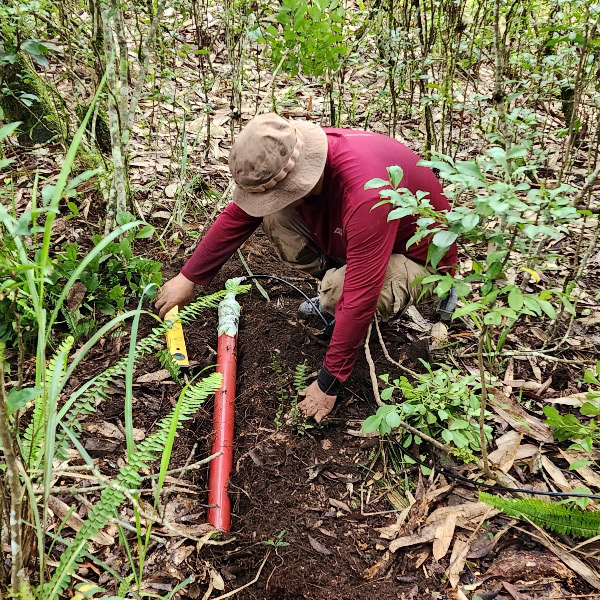
Environmental and operational constraints: mountainous terrains with rugged topography and investigation areas affected by powerline interference.
Approach
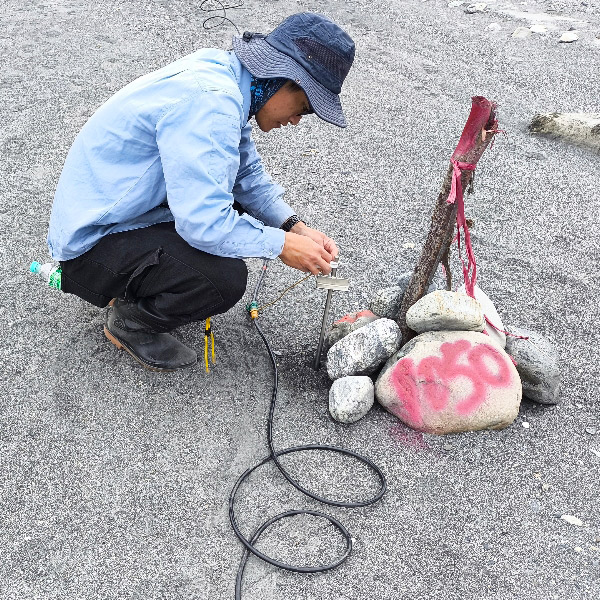
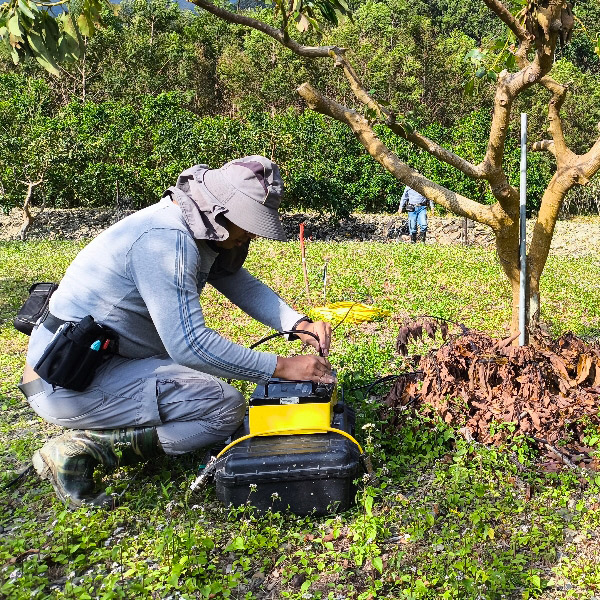
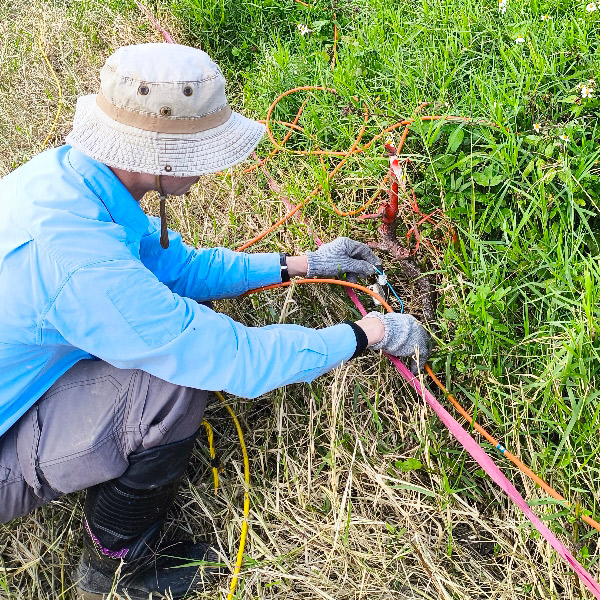
With a professional geophysical exploration team and extensive field experience, GTE has successfully developed a high-efficiency geothermal exploration methodology. Using advanced techniques such as long-profile electrical resistivity surveys and magnetotelluric (MT) methods, the team accurately interprets subsurface reservoir structures, heat source distribution, and rock characteristics.
To date, GTE has carried out investigations in key areas such as Ruisui (Hualien), Yanping (Taitung), Dongpu (Nantou), Baolai (Kaohsiung), and Yuanshan (Yilan), executing over 10,000 meters of electrical resistivity tomography (ERT) surveys and more than 100 MT survey points. These efforts have clarified the spatial distribution of geothermal reservoirs and optimized subsequent drilling plans. Through multi-scale integrated geophysical analysis, GTE can precisely delineate geothermal structural features, the distribution of hydrothermal conduits, and the permeability properties of geological formations.